
Biodiversity webinars open to all Blue Flag members
As part of the Foundational for Environmental Education (FEE) GAIA 20:30 strategy for the next decade, a series of webinars focused on Biodiversity will be organised by the Blue Flag and Green Key teams in April and May.

Launched by FEE in 2021, the GAIA 20:30 strategy represents the organisation’s commitment to contribute to a more sustainable world. As part of this strategy, FEE will be focusing its resources for the next decade on three critical environmental increasing threats to our planet – climate change, biodiversity loss and environmental pollution.
In 2022, the GAIA 20:30 will protect global biodiversity through different actions: promoting sustainable management of the coastal zone, combating pollinator and insect loss, preserving existing and creating new natural areas, and finally raising awareness of efforts to remove invasive alien species.
Several initiatives will be held within the year dedicated to Biodiversity, including a Biodiversity Competition, a course, and four webinars, conducted in April and May. The webinars, developed in partnership between Green Key International and Blue Flag International teams, will focus on different aspects of biodiversity. The first webinar will be held on April 5th and the last one, conducted in May (date to be confirmed), can be particularly relevant for the Blue Flag national operators and members since they will explore the importance of biodiversity for coastal areas.
Focused on the Importance of Biodiversity to the Tourism Industry, the first webinar hosted on April 5th will raise questions as such:
What is biodiversity?
Why is it important for tourism?
What are the negative impacts of tourism on biodiversity?
More information will be shared in the upcoming weeks on the Blue Flag page and social media on how to sign up for the Biodiversity webinars.
Blue Flag Turkey to raise awareness about responsible fishing and marine pollution
Since February, “Let’s get together in blue for future generations” project is running in Antalya, Turkey, to raise children’s awareness among sustainable fishery.
Since February, “Let’s get together in blue for future generations” project is running in Antalya, Turkey, to raise children’s awareness among sustainable fishery.

Encouraged by TÜRÇEV, the organisation running the Blue Flag programme in Turkey, this project aims to teach children between 7-13 years old about rules of amateur fishing, marine pollution and its effects on marine species. This training has been held every last Sunday of each month since its launch in February.
At the beginning of the project, the purpose was to reach a total of 600 students and their parents within one year by the end of 2019. By October 2019, 280 students from different schools and 482 of their parents have already attended to a one day educational seminar! By teaching children and their parents about marine species, Blue Flag Turkey does a great job for the protection of the environment. Involving families into this activity permits interactions between generations which is a key variable for the future of our planet.
“Today, we learned the names and functions of the fishes, fishing. Dangerous ones, ones not to be eaten and catched, for example - Ceren, age 9”
The first event of the project took place in Antalya EXPO area on February 17th with the participation of 50 students and parents. Participants kids were informed about environmental awareness, consumption habits, amateur fishing, fish species and other topics of interest. Then fishing activities have been carried out with fishing rods suitable for children. Fishes caught were put back into water after being examined delicately (no harm given) and measured on fish scale.

This project is undersigned by Ministry of Agriculture and Forestry Antalya Provincial Directorate of Agriculture and Forestry, Mediterranean Fishers and Sports Club Association (AKBADER), Touristic Air Transportation Co. (Corendon Airlines), Belek Tourism Investors Joint Venture (BETUYAB), Foundation for Environmental Education in Turkey (TÜRÇEV) and Mediterranean Research, Production and Training Institute (AKSAM).
Blue Flag French marina encourages sustainable and green modes of transport
In the south of France, Gruissan marina initiated a range of services for the tourists who want to discover the town and the hinterland in a sustainable way.
In the south of France, Gruissan marina initiated a range of services for the tourists who want to discover the town and the hinterland in a sustainable way. A successful project initiated five years ago in the municipality.

Gruissan marina received the Blue Flag award each year since 1988 and began to provide holiday-makers with sustainable modes of transport five years ago, thanks to its Odyssea Protect Eco-station. This station is a zero CO2 emission park where electric cars, ordinary and electric bikes and bus shuttles are available for the tourists. This initiative is incorporated within the framework of Odyssea - the European Network of Cities and Ports Territories – whose objective is the deployment of a new theme of tourism in Europe: “Blue Tourism”.
“This service is an answer to new demands in Tourism”, Jean-Claude MERIC, General Manager of the resort, says. Nowadays, tourists express their desire to “live an experience” during their stay. According to him, “eco-friendly transportation has gone beyond its functional dimension to become part of an innovative and appealing touristic experience.””

An interactive and cultural “Land and Sea” itinerary has been created to encourage tourists to tour the highlights of the territory from the port of Gruissan to the hinterland. This itinerary encourages sustainable and green modes of transport while introducing the help of either a professional tour guide or the use of multimedia innovation. Holiday-makers can, for example, be guided by several numerical tools featuring a pre-recorded cultural itinerary at their disposal: a spoken documentary starts each time they reach a point of interest and tells them the history of the places driven through.

Gruissan’s preserved natural environment attracts a lot of holiday-makers each summer. Its zero CO2 emissions park is an inspiring initiative contributing to the preservation of the coasts. It also illustrates how marinas are playing a key role in the economy of a destination and its tourism, such as in raising awareness of the tourists among environmental issues.
Take Care of Your Beach Project in Turkey
“You’re mortal but your waste is not” – last August, TURCEV (the Blue Flag National Operator in Turkey) spread a powerful message on one of its Blue Flag beaches
“You’re mortal but your waste is not” – last August, TURCEV (the Blue Flag National Operator in Turkey) spread a powerful message on one of its Blue Flag beaches

©Kusadasi Municipality
By the end of August, Take Care of Your Beach Project aimed to raise beach users’ awareness among beach cleanliness in Turkey. Coordinated by the National Blue Flag Operator (TURCEV) with the help of Kusadasi Municipality and Aydin Metropolitan Municipality, the initiative took place on Kadinlar Denizi beach, also called “Ladies Beach”. Volunteer university students from different universities in Turkey took part to this 4-day awareness project held on this Blue Flag beach. From kids to adults, it was the opportunity to highlight how everyone plays a key role in the coasts’ cleanliness.
“Here we see some children playing with cigarette butts with no awareness about their harm and we tried to change this sad situation during this week. I hope we won’t see this anymore” – Deniz Cansu Ogul, Middle East Technical University, Environmental Eng. Dep.”

©Kusadasi Municipality
For the occasion, several activities such as cigarette butt collection contests, interviews and questionnaires with beach users, and beach cleanliness level measurements have been presented by the volunteers. From kids to adults by way of volunteers, all of the participants became more conscious of their impact on the cleanliness of the beaches and will now be environmental ambassadors spreading environmentally-friendly practices. Nevertheless, the public only became motivated thanks to volunteers’ tenacity to inform and insist on taking actions to protect the environment.
““With this project, I realized that I also changed a lot, realising people can also change their minds with simple motivating actions. Thank you to all the people organising this powerful activity for all” – Berk Ozkizikli, Hacettepe University, Faculty of Medicine.”

©Kusadasi Municipality
TURCEV and the municipalities have held this project every year at different Blue Flag beaches since 2010. This is a good example of the work done by the Blue Flag National Operators in spreading of environmentally-friendly practices and raising the public’s awareness.
Saving water resources by replacing beach showers
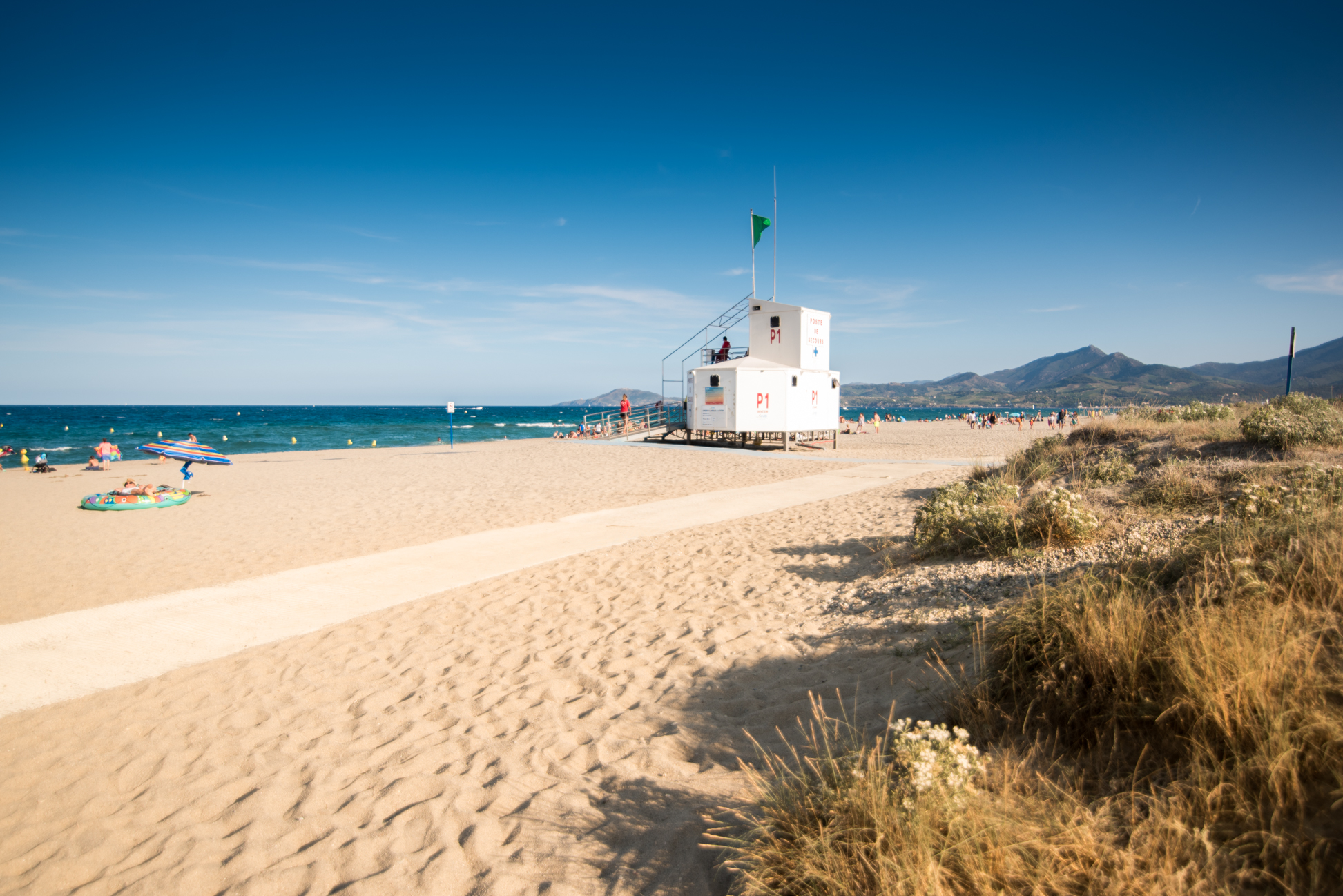
This summer, the city of Argelès-sur-Mer, France, took out its 10 beach showers to preserve water resources.
This summer, the city of Argelès-sur-Mer, France, took out its 10 beach showers to preserve water resources
©S.Ferrer
This French municipality never stopped working towards improving its footprint since it first received the Blue Flag award in 1986. A great example of a municipality dedicated to the building of a more sustainable tourism coastal industry.
The municipality’s eco-friendly initiative has permitted to replace 10 beach showers by taps. In this way, almost 8 million of drinking water have been saved*! Argelès-sur-Mer took this decision in order to save water, a natural resource which is rarefying and had to be controlled during the country’s summer heatwave. Nevertheless, beyond this idea of reducing the water consumption on the beaches, this decision has also been made to get the bad uses over with.

©S.Ferrer
This is not the only measure taken by the municipality to reduce water consumption and preserve natural resources. Since 2006, Argelès-sur-Mer and another French municipality have been working on the leak resorption of their drinking water distribution system. The city also opted for a sustainable management of its green spaces, creating spaces requiring a low water consumption. Moreover, rainwater is re-used for the one of the park’s fountains and the new stadium’s synthetic grass can be managed without water or pesticides.
Blue Flag criterion aims to reduce water consumption on its awarded sites. That is why we encourage municipalities to opt for an alternative system to store and use rainwater in order to limit the use of fresh water for watering. Argelès-sur-Mer is a good example of Blue Flag criterion’s implementation.
*Water consumption between June, 1rst, 2018 and September, 28th, 2018.