
Travel diary #1: Terry in South Africa
In October 2019, Terry the Turtle, Blue Flag’s #turtlewithoutborders, started a trip around the world to Blue Flag destinations, beginning with South Africa. Boats, marinas and beaches were all top priorities on Terry’s to-do list.
In October 2019, Terry the Turtle, Blue Flag’s #turtlewithoutborders, started a trip around the world to Blue Flag destinations, beginning with South Africa. Boats, marinas and beaches were all top priorities on Terry’s to-do list.
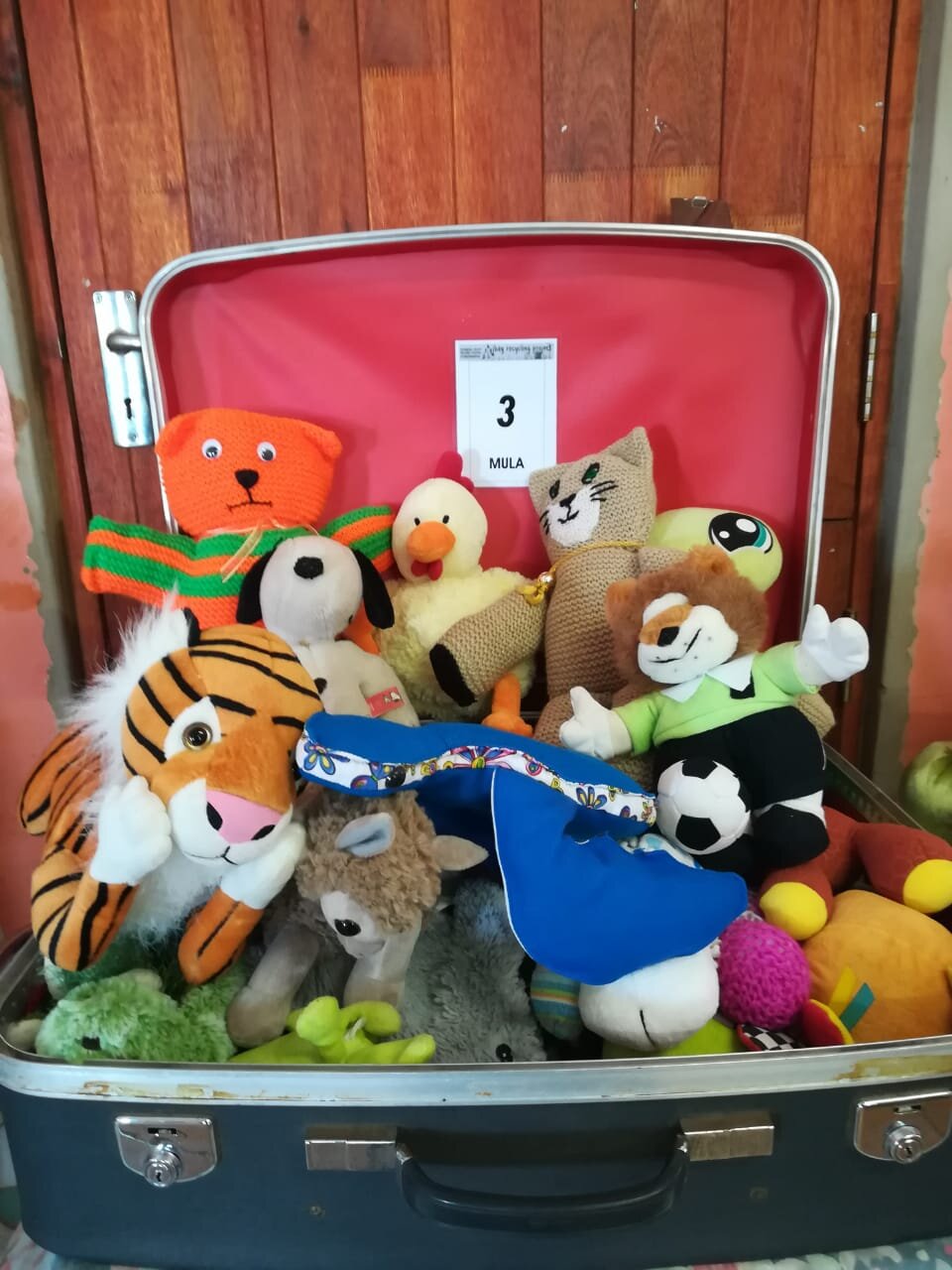
Terry is not an everyday turtle. Terry has been handmade by Moses Rombayi, a South African doll-maker coming from Zimbabwe. Moses’ love for toys guided its desire to own its business and create a unique kind of handmade dolls: thanks to him, an original Blue Flag flag became an amazing turtle!
Follow Blue Flag South Africa Instagram account (@blueflagsouthafrica) and Blue Flag International account (@blueflag_global) to discover Terry’s actions to preserve the beauty of our beaches and oceans.
Blue Flag National Operator in South Africa, WESSA, managed to show Terry as many as it could. Among all of South Africa’s Blue Flag sites, Terry saw:
Llandudno Beach in Cape Town, where Terry checked out litter conditions and cleanliness
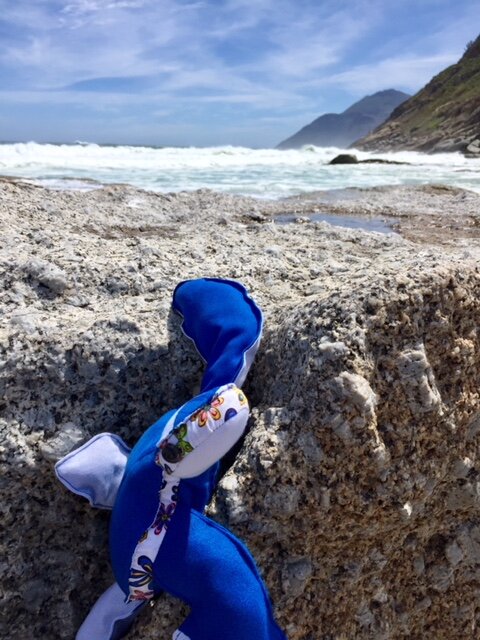
Muizenberg beach - Terry accompanied the Blue Flag team on a beach inspection and took part in Surf Emporium’s Adaptive Surfing Day for children with disabilities


Apex Predator - Terry went aboard the Great White Shark Tours boat in Gansbaai


False Bay Yacht Club Marina, where Terry approved of the immaculately clean marina as well as the organised recycling bins

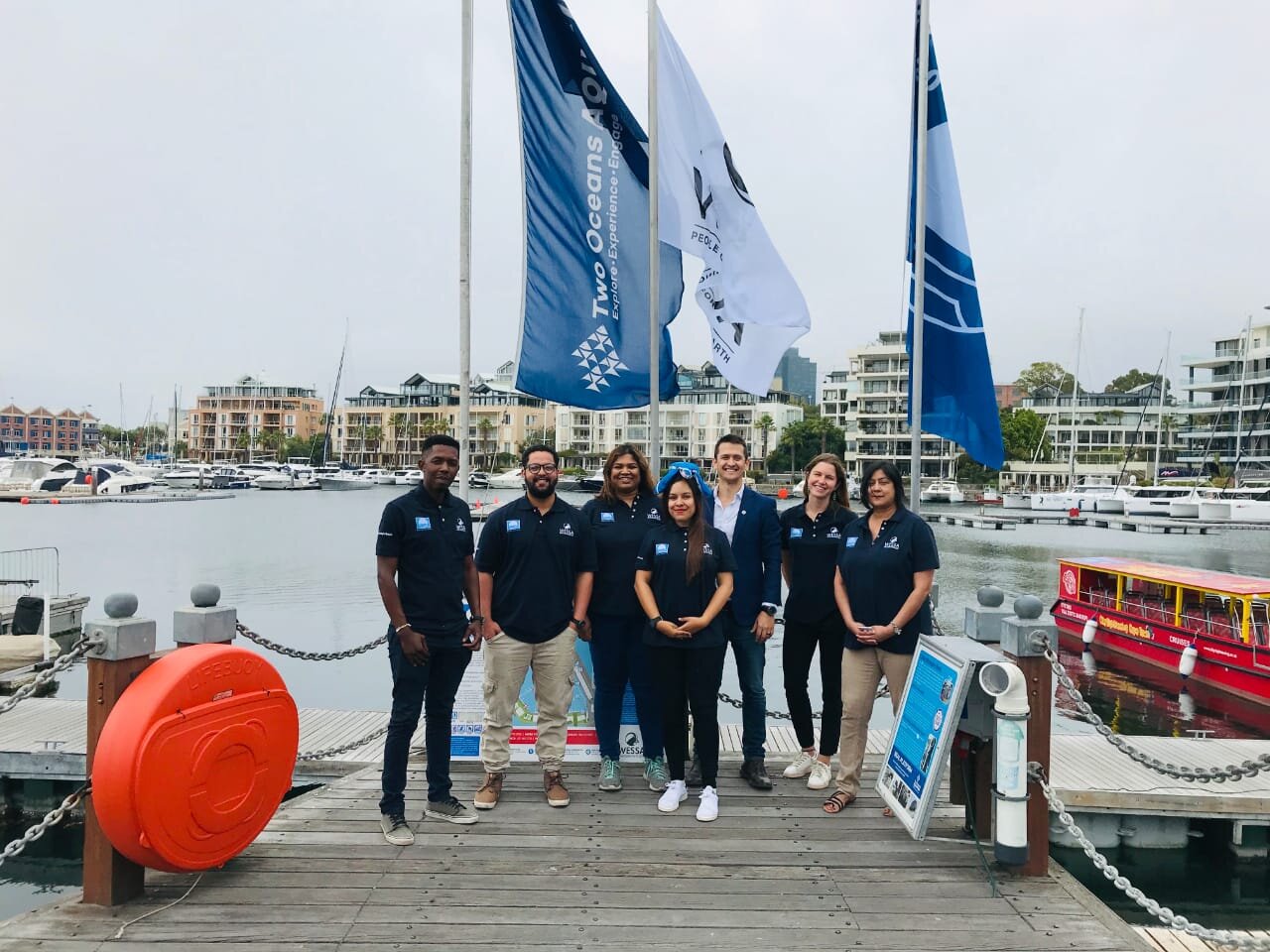
V&A Waterfront Marina hosted Terry and the WESSA team for this year’s Blue Flag launch. The rest of the WESSA team in South Africa had the pleasure of meeting Terry on this day


Dyer Island Conservation Trust, where Terry and the team met two ocean conservationists in Gansbaai and saw more shark tour boats
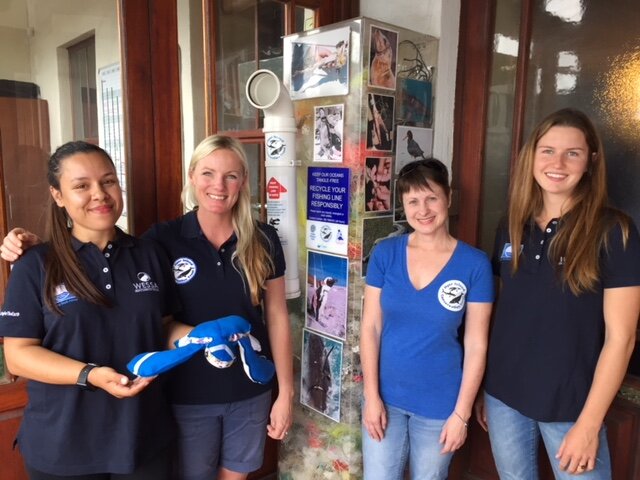
Two Oceans Aquarium allowed Terry to see how fellow marine friends inspire people to protect the oceans

Learn to Earn charity - old flags from previous seasons were donated for their sewing courses and Terry came along to see the recycling action


Boulders Beach and its penguins welcomed Terry while touring the Cape Peninsula

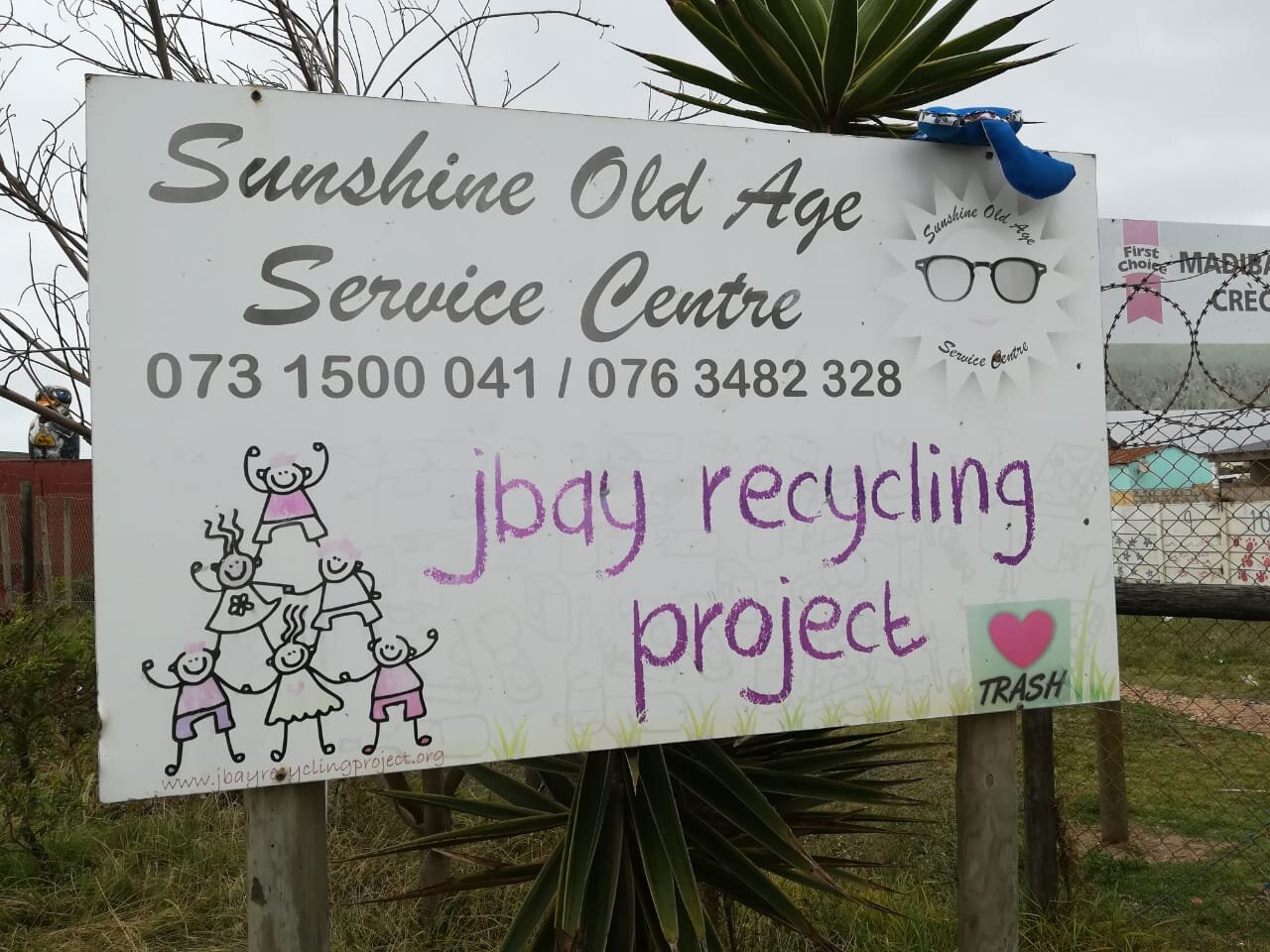
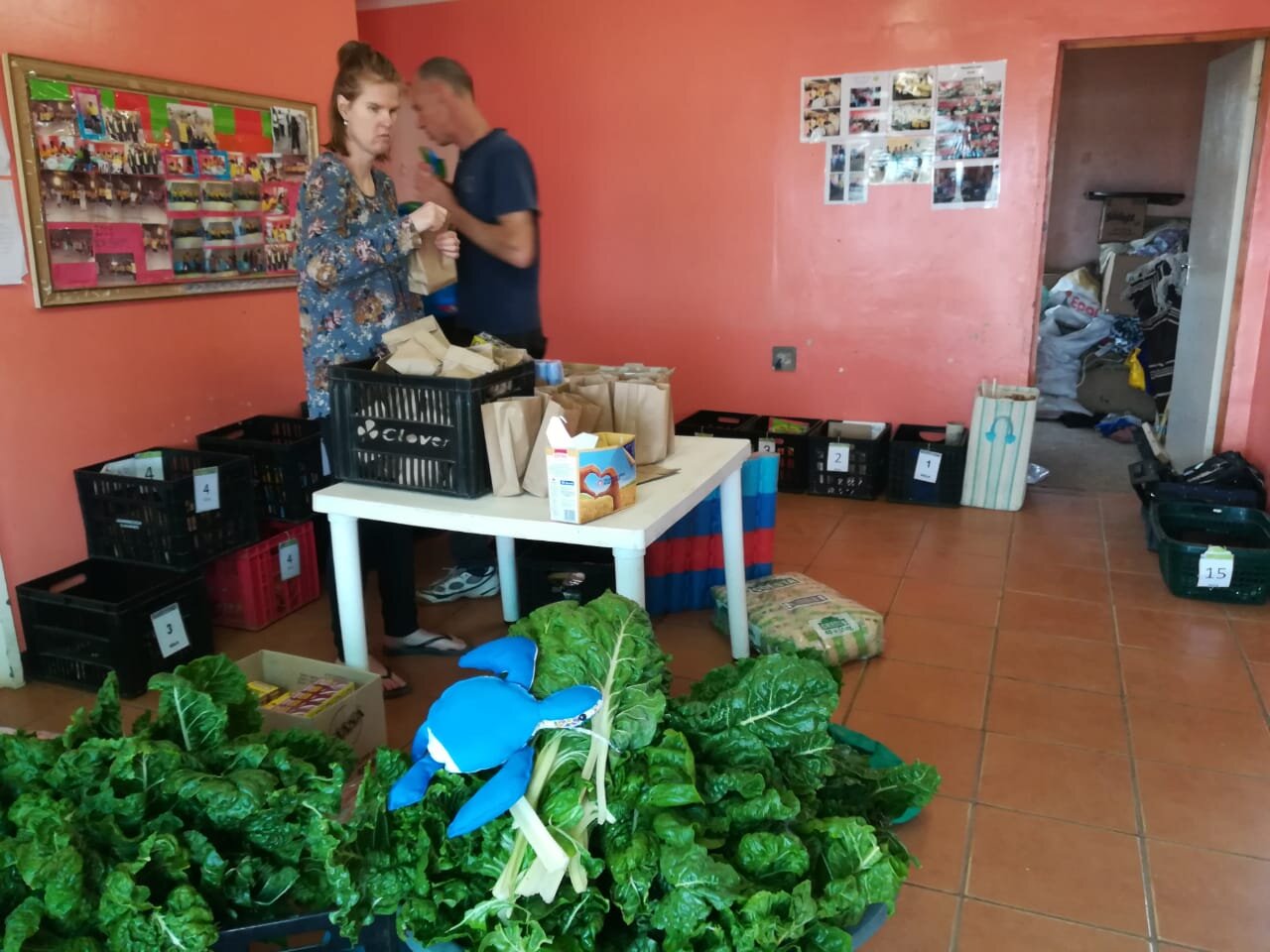
Jeffrey’s Bay Recycling Project, where Terry helped sort out the trash and show how important waste reduction and recycling are
Time will tell which country Terry will visit next!
Blue Flag growth in South America
Copenhagen, 14th November 2019 – This year, Blue Flag is happy to announce that Colombia won its first Blue Flag award whilst the United States Virgin Islands rejoined after the devastating effects of the Hurricane in 2017.
Copenhagen, 14th November 2019 – This year, Blue Flag is happy to announce that Colombia won its first Blue Flag award whilst the United States Virgin Islands rejoined after the devastating effects of the Hurricane in 2017.

Today Blue Flag releases the results of the Blue Flag International Jury meeting for the Southern Hemisphere, sharing with you the highlights of this year’s evaluation.
During the International Jury’s meeting, 150 sites have been awarded the world’s leading tourism award for the 2019-2020 Blue Flag season in the Southern Hemisphere. It represents 107 beaches, 22 marinas and 21 boats within the 7 countries running the Blue Flag programme in the Carribean, South America, Africa and Southwest Pacific. This brings the total number of Blue Flag sites worldwide to 4573 in 47 countries. The full list of awarded sites has been published on the international Blue Flag website.
After several years of implementation of the Blue Flag criteria on its beaches, Colombia has seen its application approved for 4 of its sites by the International Blue Flag Jury. Moreover, 4 beaches and a marina have been awarded the Blue Flag in the United States Virgin Islands (USVI). Countries working towards implementing the prestigious Blue Flag include Cabo Verde, Chile and the Åland Islands (Finland). India has also been investing towards obtaining the Blue Flag and currently has five pilot beaches working on receiving the award for 2020.
“We are extremely happy with the quality of work that the Colombian applicants have been putting towards obtaining the Blue Flag. It has been years of efforts, and we are proud to see Colombia has risen to the challenge. Argentina and Chile are also investing in the Blue Flag for their countries and this will strengthen our position in South America,” says Sophie Bachet Granados, International Director of the Blue Flag Programme. ”
Due to the devastating effects of the hurricanes in 2017, Trinidad and Tobago had lost their Blue Flags, and we are delighted that the US Virgin Islands have managed to rehabilitee its sites to fly the flag this season. Trinidad and Tobago is still working towards this goal.
Furthermore, as part of the candidates’ 2019 evaluation, best practices regarding accessibility have been reviewed and highly appreciated by the International Jury. Some of these year’s best practices will be featuring in our best practice database, which is freely available on our website for all to use: https://www.blueflag.global/best-practices.
The next meeting of the Blue Flag International Jury will take place on 21rst April 2020 in Copenhagen to award beaches, marinas, and boats from the Northern Hemisphere.
About the International Blue Flag Jury:
The International Blue Flag Jury is composed of representatives from the United Nations Environment Programme (UNEP), the United Nations World Tourism Organization (UNWTO), International Lifesaving Federation (ILS), the European Environment Agency (EEA), the European Union for Coastal Conservation (EUCC), the International Union for Conservation of Nature (IUCN), an Environmental Education expert, the International Council of Marine Industry Associations (ICOMIA), the European Network for Accessible Tourism (ENAT) and FEE. You can find out more about them on Blue Flag’s website.
The Blue Flag greatly appreciates the support of its sponsor, the worldwide flag producer Semaphore and Total Beach Access, which provides sponsored beach access for the disabled.
The Blue Flag programme is run by the Foundation for Environmental Education (FEE): https://www.fee.global
Feel free to check and use our copyrighted pictures for communication: https://flic.kr/s/aHsk75W98q
Blue Flag Turkey to raise awareness about responsible fishing and marine pollution
Since February, “Let’s get together in blue for future generations” project is running in Antalya, Turkey, to raise children’s awareness among sustainable fishery.
Since February, “Let’s get together in blue for future generations” project is running in Antalya, Turkey, to raise children’s awareness among sustainable fishery.

Encouraged by TÜRÇEV, the organisation running the Blue Flag programme in Turkey, this project aims to teach children between 7-13 years old about rules of amateur fishing, marine pollution and its effects on marine species. This training has been held every last Sunday of each month since its launch in February.
At the beginning of the project, the purpose was to reach a total of 600 students and their parents within one year by the end of 2019. By October 2019, 280 students from different schools and 482 of their parents have already attended to a one day educational seminar! By teaching children and their parents about marine species, Blue Flag Turkey does a great job for the protection of the environment. Involving families into this activity permits interactions between generations which is a key variable for the future of our planet.
“Today, we learned the names and functions of the fishes, fishing. Dangerous ones, ones not to be eaten and catched, for example - Ceren, age 9”
The first event of the project took place in Antalya EXPO area on February 17th with the participation of 50 students and parents. Participants kids were informed about environmental awareness, consumption habits, amateur fishing, fish species and other topics of interest. Then fishing activities have been carried out with fishing rods suitable for children. Fishes caught were put back into water after being examined delicately (no harm given) and measured on fish scale.

This project is undersigned by Ministry of Agriculture and Forestry Antalya Provincial Directorate of Agriculture and Forestry, Mediterranean Fishers and Sports Club Association (AKBADER), Touristic Air Transportation Co. (Corendon Airlines), Belek Tourism Investors Joint Venture (BETUYAB), Foundation for Environmental Education in Turkey (TÜRÇEV) and Mediterranean Research, Production and Training Institute (AKSAM).
Aero-guarded beaches: when drones and rescue teams working together
This summer, Blue Flag in Spain implemented rescue drones as an extra equipment for lifeguards on 6 Blue Flag beaches
This summer, Blue Flag in Spain implemented rescue drones as an extra equipment for lifeguards on 6 Blue Flag beaches

The Blue Flag Spanish National Operator (ADEAC) has been working with a drone company to show how the latter can be useful for lifeguards. The project was held on 6 Spanish municipalities with Blue Flag awarded sites: Santa Eularia, Ciutadella, Sagunto, Fuengirola, Cheles y Orellana. This equipment can also be useful for sewage control and monitoring.
The rescue drones have been implemented during one week on the selected Blue Flag beaches. This initiative showed how drones can help reinforcing the beach safety thanks to their minimum response time and reliability. These pilot tests aimed to highlight the benefits for lifeguards regarding security’s improvement on the beaches and thus create a model that could be spread out.
Indeed, these drones combine surveillance, rescue and search skills. They can be helpful for the lifeguards regarding the monitoring of the beach in real time, determining the victims or dangerous animals’ position in the sea as well as controlling rush hours. This search and rescue drone has been designed to fit a beach’s harsh conditions (level 6 winds, rain, sand and saline environments).
This pioneering initiative from the Spanish Blue Flag National Operator illustrates how technological innovation can be useful for both holiday-makers and lifeguards at the beach. This experiment could be the beginning of new standards as an example to the rest of the world’s beaches.
Blue Flag National Operator Meeting 2019
The Blue Flag National Operator Meeting gathered over 50 participants on 8-9 October. This two-day event was held by Keep Britain Tidy, Blue Flag National Operator in England.
The Blue Flag National Operator Meeting gathered over 50 participants on 8-9 October. This two-day event was held by Keep Britain Tidy, Blue Flag National Operator in England.

The Blue Flag National Operator Meeting is a technical event where the status and developments of the programme are discussed. It is an opportunity for our National Operators to discuss and exchange ideas about the technicalities of the programme, as well as best practices.
This meeting was the occasion to share and improve new ideas for the months and years to come with the members of the Blue Flag network. From our new member Terry the Turtle (a handmade turtle doll travelling around the world to fight plastic pollution) to a best practices competition, 2020 promises to be exciting!
Blue Flag International would like to thank our National Operator in England, Keep Britain Tidy, for hosting this 2019 meeting, as well as the Blackpool Council for supporting the event.
Blue Flag French marina encourages sustainable and green modes of transport
In the south of France, Gruissan marina initiated a range of services for the tourists who want to discover the town and the hinterland in a sustainable way.
In the south of France, Gruissan marina initiated a range of services for the tourists who want to discover the town and the hinterland in a sustainable way. A successful project initiated five years ago in the municipality.

Gruissan marina received the Blue Flag award each year since 1988 and began to provide holiday-makers with sustainable modes of transport five years ago, thanks to its Odyssea Protect Eco-station. This station is a zero CO2 emission park where electric cars, ordinary and electric bikes and bus shuttles are available for the tourists. This initiative is incorporated within the framework of Odyssea - the European Network of Cities and Ports Territories – whose objective is the deployment of a new theme of tourism in Europe: “Blue Tourism”.
“This service is an answer to new demands in Tourism”, Jean-Claude MERIC, General Manager of the resort, says. Nowadays, tourists express their desire to “live an experience” during their stay. According to him, “eco-friendly transportation has gone beyond its functional dimension to become part of an innovative and appealing touristic experience.””

An interactive and cultural “Land and Sea” itinerary has been created to encourage tourists to tour the highlights of the territory from the port of Gruissan to the hinterland. This itinerary encourages sustainable and green modes of transport while introducing the help of either a professional tour guide or the use of multimedia innovation. Holiday-makers can, for example, be guided by several numerical tools featuring a pre-recorded cultural itinerary at their disposal: a spoken documentary starts each time they reach a point of interest and tells them the history of the places driven through.

Gruissan’s preserved natural environment attracts a lot of holiday-makers each summer. Its zero CO2 emissions park is an inspiring initiative contributing to the preservation of the coasts. It also illustrates how marinas are playing a key role in the economy of a destination and its tourism, such as in raising awareness of the tourists among environmental issues.
Triscovery and Blue Flag join forces to enhance marine and coastal sustainability practices
Triscovery Srl and the Blue Flag programme have signed a Memorandum of Understanding (MOU) that will enhance and share marine and coastal sustainability practices among the community of boating tourism operators.
Copenhagen – 25 september 2019, Triscovery Srl and the Foundation for Environmental Education through its Blue Flag programme, have signed a Memorandum of Understanding (MOU) on September 16, 2019 that will enhance and share marine and coastal sustainability practices among the community of boating tourism operators.

©Blue Flag Puerto Rico
Triscovery is the first online platform that allows travelers to discover and book the best day trips and boat events in advance. Every year, thousands of travelers live truly unique boating experiences, the exploration of the most beautiful coasts and islands. A very strict policy based on customer satisfaction and environmental protection are applied to Triscovery fleet. Through the Marketplace, the boating operators introduce their experiences and allow to book in real time and in total safety, with coverage in the event of bad weather and sea conditions.
All tour operators that offer boat-based tourism activities and that embrace sustainable practices in line with the Blue Flag criteria could be eligible for an application to become a Blue Flag accredited sustainable boating tourism operator. This includes seeing environmental education as an integral part of the tourism products, assessing and making an effort to reduce negative impacts on the economic, social and natural environment, considering the needs of tourists, its employees and the environment and contributing to the development and distribution of sustainable practices.
“Fabrizio Badalucco, Ceo of Triscovery, comments: “The signing of the MoU marks a new milestone in the work of Triscovery that leads to boost the environmental policy among our boating operators across the Mediterranean area. We are proud to be the first company that make possible this kind of collaboration aimed to doing boating business according to sustainability and respecting the environment. We hope that other companies and investors can join and finance industry that are compliant with the blue economy.”

©Blue Flag Turkey
“The Oceans are at risk, and through Blue Flag we are striving to make a difference in marine litter, biodiversity and other key aspects for our Blue planet. It is vital that the tourism industry aligns itself with sustainable development practices, which is what our framework provides. We are excited to work with more operators through Triscovery’s network,” says Sophie Bachet Granados, Director of the Blue Flag programme.”
The Blue Flag programme for beaches, marinas and sustainable boating tourism operators is run by the international, non-governmental, non-profit organisation Foundation for Environmental Education. The Blue Flag programme started in France in 1985. It has been operating in Europe since 1987 and in areas outside of Europe since 2001. Today, Blue Flag has become a truly global programme with an ever-increasing number of countries participating in this global effort, with 50 countries in its network and more than 4,500 awarded beaches, marinas and ecotourism boats.
Triscovery - Media Relations:
+39 393 8942947
Blue Flag - Media Relations:
+4561248081
sophie@fee.global
Take Care of Your Beach Project in Turkey
“You’re mortal but your waste is not” – last August, TURCEV (the Blue Flag National Operator in Turkey) spread a powerful message on one of its Blue Flag beaches
“You’re mortal but your waste is not” – last August, TURCEV (the Blue Flag National Operator in Turkey) spread a powerful message on one of its Blue Flag beaches

©Kusadasi Municipality
By the end of August, Take Care of Your Beach Project aimed to raise beach users’ awareness among beach cleanliness in Turkey. Coordinated by the National Blue Flag Operator (TURCEV) with the help of Kusadasi Municipality and Aydin Metropolitan Municipality, the initiative took place on Kadinlar Denizi beach, also called “Ladies Beach”. Volunteer university students from different universities in Turkey took part to this 4-day awareness project held on this Blue Flag beach. From kids to adults, it was the opportunity to highlight how everyone plays a key role in the coasts’ cleanliness.
“Here we see some children playing with cigarette butts with no awareness about their harm and we tried to change this sad situation during this week. I hope we won’t see this anymore” – Deniz Cansu Ogul, Middle East Technical University, Environmental Eng. Dep.”

©Kusadasi Municipality
For the occasion, several activities such as cigarette butt collection contests, interviews and questionnaires with beach users, and beach cleanliness level measurements have been presented by the volunteers. From kids to adults by way of volunteers, all of the participants became more conscious of their impact on the cleanliness of the beaches and will now be environmental ambassadors spreading environmentally-friendly practices. Nevertheless, the public only became motivated thanks to volunteers’ tenacity to inform and insist on taking actions to protect the environment.
““With this project, I realized that I also changed a lot, realising people can also change their minds with simple motivating actions. Thank you to all the people organising this powerful activity for all” – Berk Ozkizikli, Hacettepe University, Faculty of Medicine.”

©Kusadasi Municipality
TURCEV and the municipalities have held this project every year at different Blue Flag beaches since 2010. This is a good example of the work done by the Blue Flag National Operators in spreading of environmentally-friendly practices and raising the public’s awareness.
Saving water resources by replacing beach showers
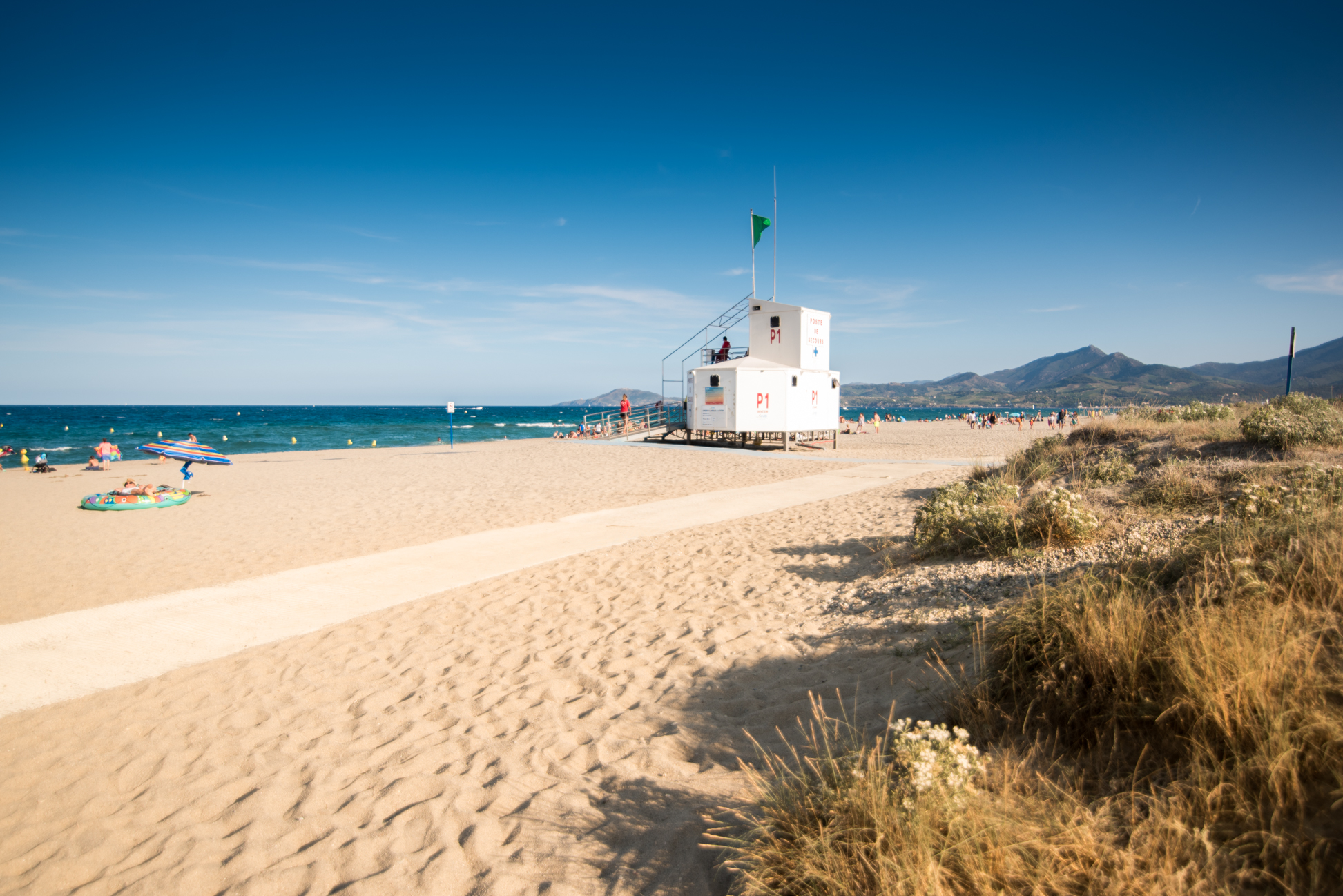
This summer, the city of Argelès-sur-Mer, France, took out its 10 beach showers to preserve water resources.
This summer, the city of Argelès-sur-Mer, France, took out its 10 beach showers to preserve water resources
©S.Ferrer
This French municipality never stopped working towards improving its footprint since it first received the Blue Flag award in 1986. A great example of a municipality dedicated to the building of a more sustainable tourism coastal industry.
The municipality’s eco-friendly initiative has permitted to replace 10 beach showers by taps. In this way, almost 8 million of drinking water have been saved*! Argelès-sur-Mer took this decision in order to save water, a natural resource which is rarefying and had to be controlled during the country’s summer heatwave. Nevertheless, beyond this idea of reducing the water consumption on the beaches, this decision has also been made to get the bad uses over with.

©S.Ferrer
This is not the only measure taken by the municipality to reduce water consumption and preserve natural resources. Since 2006, Argelès-sur-Mer and another French municipality have been working on the leak resorption of their drinking water distribution system. The city also opted for a sustainable management of its green spaces, creating spaces requiring a low water consumption. Moreover, rainwater is re-used for the one of the park’s fountains and the new stadium’s synthetic grass can be managed without water or pesticides.
Blue Flag criterion aims to reduce water consumption on its awarded sites. That is why we encourage municipalities to opt for an alternative system to store and use rainwater in order to limit the use of fresh water for watering. Argelès-sur-Mer is a good example of Blue Flag criterion’s implementation.
*Water consumption between June, 1rst, 2018 and September, 28th, 2018.
Baja California Sur states the restriction of use of plastics
The Mexican state takes great steps to abandon the culture of plastic to protect the world’s aquarium.
The Mexican state takes great steps to abandon the culture of plastic to protect the world’s aquarium

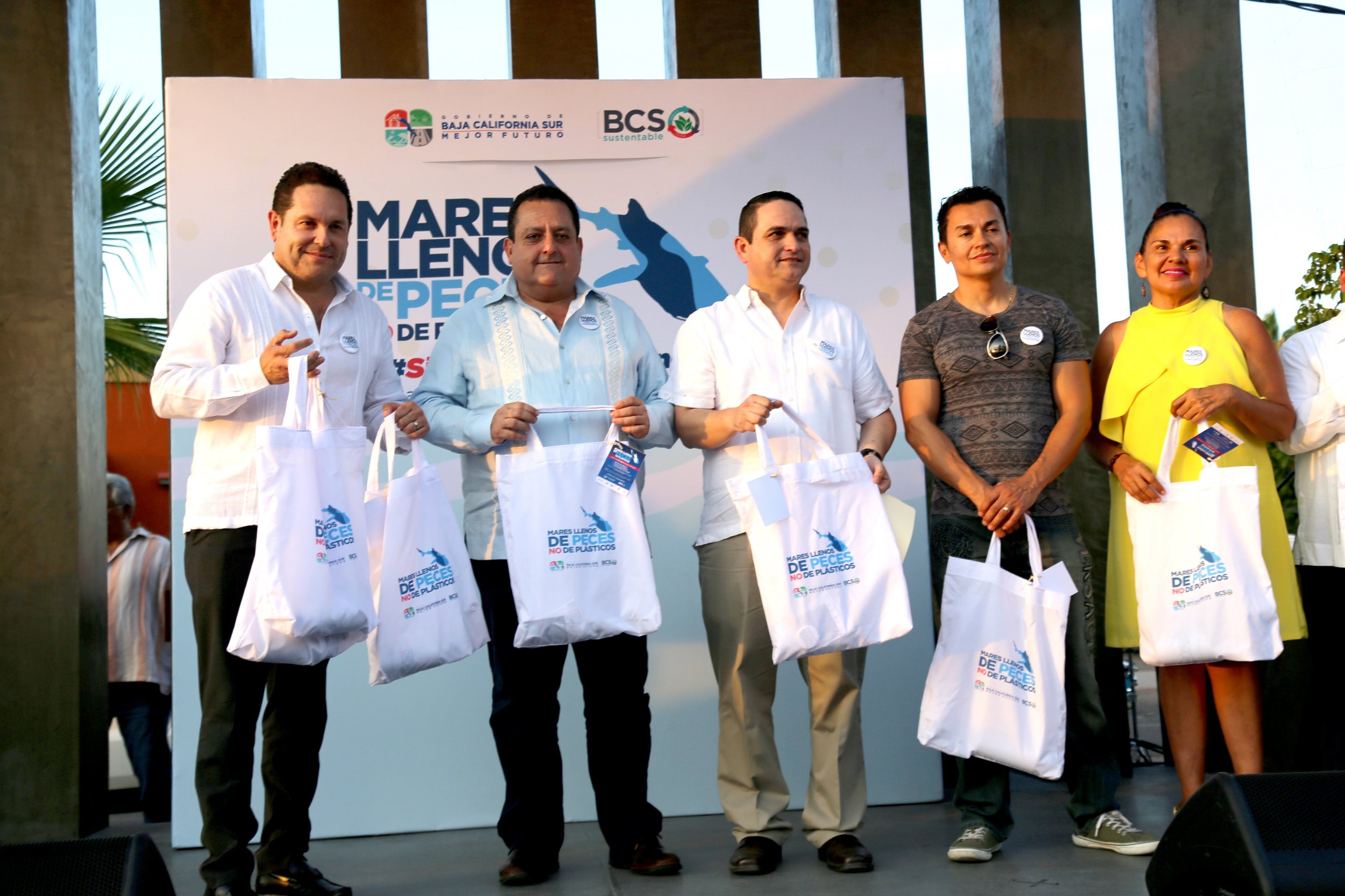
This August, Baja California Sur (BCS) took measures to preserve and protect its marine biodiversity. The latter is key to success of the state’s tourism industry since this Mexican state counts 20 beaches and a marina awarded with Blue Flag.
This initiative was supported by the Government of Baja California Sur along with the City Councils of La Paz, Los Cabos, Comondú, Loreto and Mulegé. The statement concerns the restriction of use of plastic bags, straws and Styrofoam containers in supermarkets, restaurants, self-service stores, pharmacies, as well as for purposes of wrapping or moving food and drinks. The state aims to end up the use of all these materials by 2021.
“Baja California Sur is taking great steps to abandon the culture of plastic, we treasure our natural heritage, so we will not hesitate to protect it,” said Luis Araiza, the head of the Secretary of Tourism, Economy and Sustainability (SETUES) of BCS.”

More than just prohibiting the use of plastics, the announcement aims for raising public awareness about this issue to preserve oceans from pollution. Baja California Sur is the first Mexican state to sign the UN Environment global campaign “Mares Limpios” (“Clean Seas”) along with 57 countries.
“Today BCS is a reference in Mexico according to environmental matters. We want our children and their future generations to breathe fresh air and have transparent seas full of fish, it is their right and it is our obligation”, said Araiza López.”
SETUES provide talks about environmental care and conservation to children from elementary schools. Recently, Governor Carlos Mendoza also launched the “Sin Plastico Challenge (“Without plastic challenge”) in order to impulse good practices that could help to reduce climate change. Moreover, 7 000 plants have been delivered to reforest the state thanks to the “Sembremos un Mejor Futuro” (“Sow a better future”) programme.
“Baja California Sur is a destination that strives, grows and lives up to the circumstances that prevail in the international tourism market and that includes the formal commitment to the environment,” said Luis Humberto Araiza.”
As tourism industry is the main economic driving force of the state, the latter wants to contributes to the spreading of environmentally-friendly practices preserving the area and its biodiversity. The Government definitely strives to keep our seas full of fishes, not plastics.
Mexican beach achieving a Blue Flag perfect rating reiterate its award
Tangolunda Dream Beach, Mexico, obtained a 100% compliance rating in the 33 imperative and guideline Blue Flag criterion for the season 2018-2019.
Tangolunda Dream Beach, Mexico, obtained a 100% compliance rating in the 33 imperative and guideline Blue Flag criterion for the season 2018-2019.

Managed by Dreams Huatulco Resort & Spa, the beach was one of the 54 beaches recognized by Blue Flag in Mexico for the 2018-2019 season. This beach achieved this perfect rating regarding Blue Flag imperative and guideline criterion thanks to the Resort’s commitment for the conservation of environment.
The Resort launched a “sustainable schools” programme in local schools to educate children to sustainable development revolving around water, energy, waste, biodiversity, culture and health education. For instance, the activity implemented during the past school year was linked to local sustainable agents. While one group of kids was monitoring the energy consumption of its house and school in order to implement savings solutions, another one was carrying out activities about environmental protection. It helped raising children’s awareness about wind power while involving the hotel staff, teachers, parents and kids.
Moreover, Dreams Huatulco Resort & Spa did a theoretical estimation of carbon dioxide equivalent per host. Based on the number of guests in each country, they calculated the CO2 produced by a plane regarding guests’ living country and Huatulco.

Tangolunda Dream Beach is surrounded by lush jungle, soaring mountains and dazzling coral reefs that need to be protected. It is also the home of sea turtles which hatch seasonally from July through December. Protecting this beach also go through the protection of this sea turtle population and the guarantee that the babies take their first steps towards their home in the ocean.
The Resort’s work illustrates how sustainability encompasses the economic, the social and the environmental. Tangolunda Dream Beach is an example of a great commitment to preserve our oceans.
Tidy up cigarette butts with #FillTheBottle challenge
The idea is simple: you collect the cigarette butts that you find in nature and fill a bottle with them. This challenge has spread to the Blue Flag beaches.
This challenge has spread to the Blue Flag French beaches.
The idea is simple: you collect the cigarette butts that you find in nature and fill a bottle with them. This challenge initiated at the beginning of August by a French student on Twitter immediately went viral on social media and became an international concern. The “Fill the bottle challenge” requests citizens’ involvement to preserve the environment and raises awareness about cigarette butts’ impact on our ecosystem.

Since August, 6th, The French city of Torreilles encourages residents and tourists to take up the challenge. The city is part of the second French region with the most Blue Flag awarded sites, a region where other Blue Flag beaches launched the challenge too.
Each second, 137 000 cigarette butts are thrown out on the ground worldwide. Even though we know that they take between 12 and 25 years to decompose, several thousands of cigarette butts end up in seas and oceans each year. Thus undersea species are endangered by people discarding their cigarettes without a second thought, given that one and only cigarette butt can pollute 5000 litres of water.
The results of the challenge are impressive, but it is bittersweet as cigarette butts are the most littered item around the world. You should be surprised by how many never get collected. Unfortunately, you can gather them for a few minutes and you will be sure your bottle will be full. This is why the most important message is to educate the smokers to dispose of their cigarette butts in an environmentally safe way. Blue Flag and the city of Torreilles are also working towards this education, for a longer sustainable impact on the future.
The #FillTheBottle challenge taking place in Torreilles is such a good action to preserve the environment. Nevertheless, people have to make sure that they don’t throw away the bottle the same way the cigarette butts have been tossed out! That is why they are all collected by the tourism office in exchange for a hat of the city.
By taking up the challenge, the city of Torreilles proves its engagement for the planet and gives an example of an action preserving beaches, seas and oceans from pollution. This is another guarantee to find Blue Flag beaches clean!
Holiday-makers involved in Croatian protected species defence
In Cres, Camp Kovačine raises its guests’ awareness about environmental protection thanks to interactive activities suitable for both kids and their parents.
In Cres, Camp Kovačine takes action to protect the island’s large number of protected animal and flora species.
Camp Kovačine raises its guests’ awareness about environmental protection thanks to interactive activities suitable for both kids and their parents. Two years ago, the Camp launched a new activity called “What if”. This project began with lectures on the protection of protected animal species, followed by an art workshop on protected animals and themed social games. Thanks to this initiative, guests receive information concerning Cres’ impressive fauna and flora and the best behaviour to adopt concerning protected species.

“And when we go with the boat to the sea trip- what if we see dolphins? Can we feed them? Can we follow them with a boat? Do they like swimming with humans or they actually get scared and become aggressive? / Tina Gams-Fučić, the quality manager of camping Kovačine and project manager for ecology.”
By teaching beach visitors, employees and children how to deal with the island protected species, Camp Kovačine does a great job for the protection of the environment. Involving the kids and their parents into this activity permits interactions between generations which is a key variable for the future of our planet. Through this, guests understand that each action (or inaction) matters and will apply this mind-set their entire life. For example, they now know that pulling out from the sea Pinna Nobilis (a marine mollusc) can be punished by a fine or prison term.

It is not first Camp Kovačine’s initiative to raise its guests’ environmental consciousness. Last year, the campsite’s eco-theatre made children aware of their possibilities to protect the species since animators dressed like dolphins, flowers or birds were threatened by a plastic bag. Indeed, plastic pollution and climate change were the two mains topics of the piece and also are at the top of the Camp’s environmental policy.
“Our objective is to teach beach visitors, employees and children how to deal with protected animal species. Our main message, of course, is conservation and protection of protected animal species. also said Tina Gams-Fučić”
Camp Kovačine contributes to the prevention of climate change by showing its guests that they have to be active for our environment. With 95 Blue Flag beaches and 27 marinas in the country, that kind of activities helps a lot keeping Croatia’s exceptional and diverse natural beauty.
New partnership to enhance wheelchair accessibility to the coast
People with disabilities can now easily find out if they can get access to the 4,500 Blue Flag beaches, marinas or boating tourism operators through a new partnership with Wheelmap.org.
People with disabilities can now easily find out if they can get access to the 4,500 Blue Flag beaches, marinas or boating tourism operators through a new partnership with Wheelmap.org.
Wheelmap is a free online map for finding and rating wheelchair accessible places worldwide. The project is run by the nonprofit organisation “Sozialhelden”, a disability rights organisation based in Berlin. The Blue Flag partnership with Wheelmap.org is a step forward to improving the coasts’ ease of access and providing information about wheelchair accessible facilities. The Blue Flag listings on Wheelmap contain a direct link to the blueflag.global website, so that users can also benefit from all the detailed information which is provided there.

Credits: DICOM
How does it work?
Wheelmap rates the wheelchair accessibility of public places such as public transport, restaurants, playgrounds and tourism sites worldwide, using a smart traffic light system. The colors green, yellow and red indicate if a place is fully, partially or not wheelchair accessible. As everyone can easily update a site´s rating by using its app or web application, Wheelmap helps to increase the availability of accessibility information for people with disabilities. The Blue Flag sites have now become part of a collection of nearly 1 million public places rated by the Wheelmap community and additional information on another 500,000 places which is provided by dozens of partner organisations. An example of an accessible Blue Flag boating operator as it is listed on Wheelmap can be found here.
“We are very pleased that our two projects, which promote sustainable and equitable tourism in very different ways, have joined forces. We are working together to make accessibility information easily available to millions of people with mobility impairments who want to enjoy the coast and all it has to offer.
Svenja Heinecke, Wheelmap Community Manager”

Credits: DICOM
With more than 4,500 awarded sites in 45 countries around the world, Blue Flag plays a key role in spreading inclusive initiatives in the coastal tourism industry.
“We want the public to be able to choose the best site depending on their needs, as all offer different levels of accessibility. It can be to the site, or in the water itself, which is a huge difference on how you experience the coast. We are extremely happy to be able to share our data to Wheelmap, a dedicated platform for international accessibility.
Sophie Bachet Granados, International Blue Flag Director”
'H2O on the Go' scheme to help fight plastic pollution
The Borough Council of Causeway Coast and Glens, awarded with a number of Blue Flags in the season 2019, has recently launched the ‘H2O on the Go’ project, that aims at fighting plastic pollution in the sea.
Every minute, about 1 million plastic bottles are bought around the world. In 2016 480 billion were sold and this is expected to increase to 583.3 billion by 2021. Many of these are not recycled and end up into the sea, endangering its biodiversity and us all.

The Borough Council of Causeway Coast and Glens, awarded with a number of Blue Flags in the season 2019, has recently launched the ‘H2O on the Go’ project, that aims at fighting plastic pollution in the sea.
The message that ‘H2O on the Go’ wants to deliver is to drink more tap water and use reusable bottles also outside home, raising beach visitors’ awareness on single-use plastic and its impact on the oceans.
Businesses and other outlets across Causeway Coast and Glens are encouraged to take part into the scheme. These will be promoting and offering free refilling of water bottles to reduce the amount of single use plastic bottles in circulation. The location and names of the participating businesses are accessible through the Council’s website www.causewaycoastandglens.gov.uk, so as to allow visitors to include a water refill point when planning their visits to the beaches of the area.
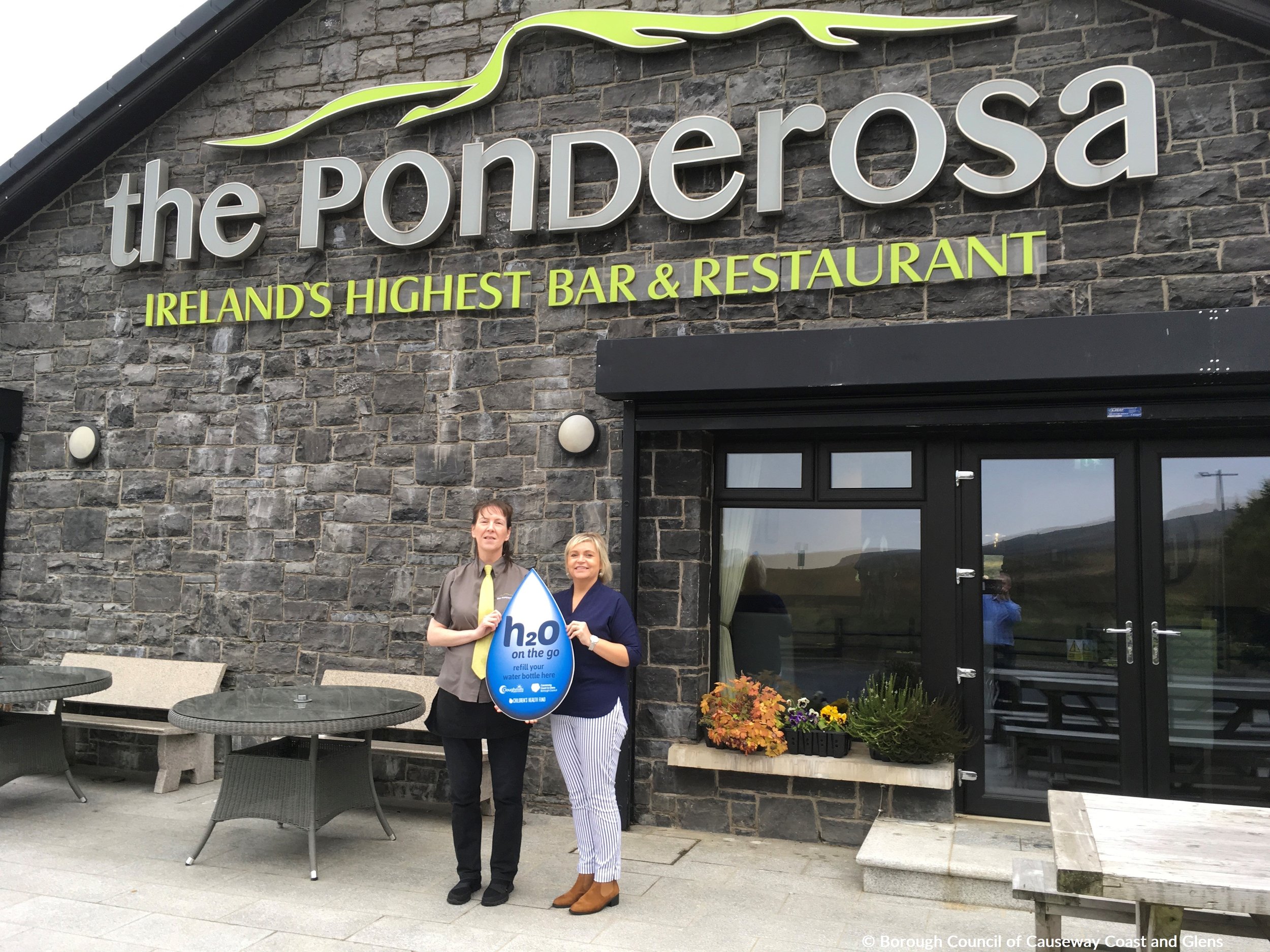
The Blue Flag programme in Northern Ireland is managed by our member organisation ‘Keep Northern Ireland Beautiful’. You can visit their website here: https://www.keepnorthernirelandbeautiful.org/cgi-bin/greeting?instanceID=1
Contributing to SDG 14 with the smurfs
On the 60th Anniversary of the creation of the Smurfs, Blue Flag Spain has been chosen to support a ‘smurfs project’ focusing on Sustainable Development Goal number 14 on the sustainable use the oceans, seas and marine resources.
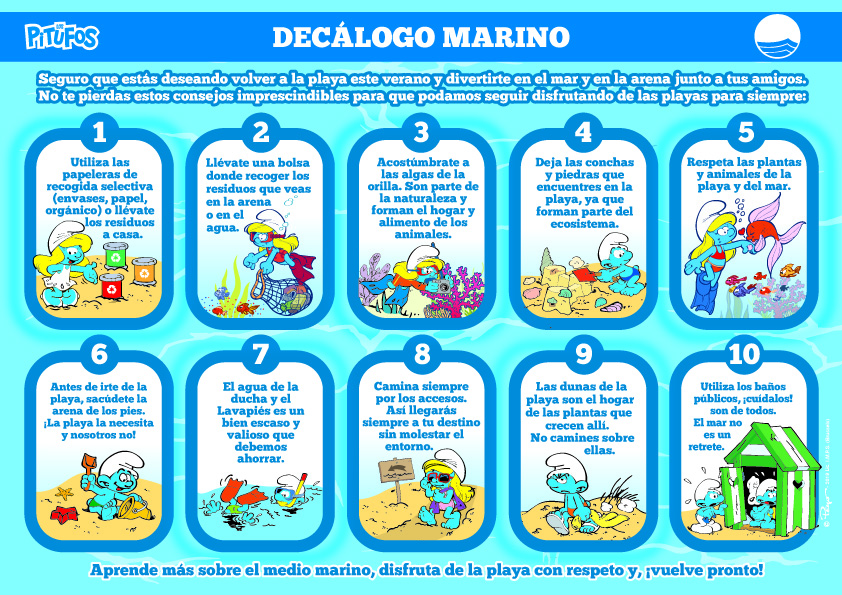
On the 60th Anniversary of the creation of the Smurfs, Blue Flag Spain has been chosen to support a ‘smurfs project’ focusing on Sustainable Development Goal number 14 on the sustainable use the oceans, seas and marine resources. Blue Flag Spain and Smurfs have drafted a Decalogue with dos and don’ts at the beach, such as using the accesses instead of walking through the dunes and not collecting stones or shells from the beach.
The Decalogue will be posted in the Spanish Blue Centers, Blue Flag beaches and marinas. Moreover, in a series of Blue Flag beaches, there will be a space with games for children to learn more about the sea and its protection.
Additionally, a photo contest for children has been launched to promote good environmental practices on environmental conservation both in natural areas and at home.
What does the Decalogue say?
Use the recycling bins or bring the waste back home.
Bring a bag to pick up the litter you find on the beach or in the water.
Get used to the algae you find on the shore. They are part of the nature and they can be food for the animals.
Do not pick up the shells and the stones you find on the beach, they are part of the ecosystem.
Respect animals and plants from the beach and the sea.
Before leaving the beach, shake the sand off your feet. The beach needs it, we do not!
The water from the showers and the ‘footbath’ is a scarce and valuable resource that we need to preserve.
Always walk on the walking paths. This way, you can reach your destination without damaging the environment.
The dunes are the home of the plants that grow on it. Do not walk on them.
Use the public toilet and take care of them, as they are for everyone. The sea is not a toilet.

Accessibility and the expansion of Blue Flag in Asia at the centre of attention in the 2019 Blue Flag Northern Hemisphere awards
This year, we are happy to announce that South Korea won its first Blue Flag award, thus increasing the presence of Blue Flag in Asia.
Copenhagen, 27 May 2019 – This year, we are happy to announce that South Korea won its first Blue Flag award, thus increasing the presence of Blue Flag in Asia. Accessibility was the hot topic of this year’s work, both for the international jury discussion and our programme development.
For the 2019 season, the Blue Flag International Jury has awarded the world’s leading tourism ecolabel to more than 4,400 beaches, boats and marinas in the Northern Hemisphere. This brings the total number of Blue Flag sites worldwide to 4,560, in 45 countries. All northern hemisphere countries have held their national award ceremonies and results for the network are now displayed on www.blueflag.global.

Today we release the results of the Blue Flag International Jury meeting for the Northern Hemisphere, sharing with you the highlights of this year’s evaluation. Here you will be able to read about our new Blue Flag awarded beach in Asia and the new developments regarding accessibility and Blue Flag boats.
After several years of implementation of the Blue Flag criteria on its beach, Wando County in South Korea has seen its application for Sinji Myeongsasimri Beach approved by the International Blue Flag jury. This first beach in South Korea joins the four Blue Flag beaches awarded in Japan and further increases Blue Flag’s reach in the Asian region.
Moreover, as part of the candidates’ 2019 evaluation, best practices regarding accessibility have been reviewed and highly appreciated by the International Jury. Some of these year’s best practices will be featuring in our best practice database, which is freely available on our website for all to use: https://www.blueflag.global/best-practices. To improve the countries’ accessibility practices, Blue Flag has also entered into a partnership with Total Beach Access.
“This is a unique project, which we have worked very hard on in the past months. It will enable our sites to have accessibility material at little or no cost through the use of sponsorship. Our partners, the European Network for Accessible Tourism and the United World Tourism Organisation, have both expressed their favour for this partnership, seen as a unique set-up which could be a game-changer for beaches worldwide”, says Sophie Bachet Granados, International Blue Flag Director.
Additionally, it is worth mentioning that our new development in 2016 lead us to award Sustainable Boating Tourism Operators (SBTOs). These boats conduct various touristic activities, such as nature or whale watching, city canal tours, scuba diving or recreational fishing, and must be part of the integrated coastal management plan of a region. Already 67 boats have joined us worldwide and are receiving their certification in 2019. “This is just the beginning as we are working hand in hand with Sail Training International towards finalizing a set of criteria for Sail Training Vessels which should be launched in 2020. By increasing our fleet of awarded boats, we aim to increase our positive impact on the oceans!” concludes Sophie.

About the International Blue Flag Jury:
The International Blue Flag Jury is composed of representatives from the United Nations Environment Programme (UNEP), the United Nations World Tourism Organization (UNWTO), International Lifesaving Federation (ILS), the European Environment Agency (EEA), the European Union for Coastal Conservation (EUCC), the International Union for Conservation of Nature (IUCN), United Nations Educational, Scientific and Cultural Organisation (UNESCO), the International Council of Marine Industry Associations (ICOMIA), the World Cetacean Alliance (WCA), the European Network for Accessible Tourism (ENAT) and FEE. You can find out more about them on Blue Flag’s website: https://www.blueflag.global/international-jury.
Note that the next meeting of the Blue Flag International Jury will take place in September to award beaches, marinas and boats from the Caribbean, South America, Africa and southwest Pacific. India and Colombia, who have been working hard on the implementation of the Blue Flag programme for the past few years, might be the next ones to join the Blue Flag network with some awarded sites after this International Jury meeting.
Countries working towards implementing the prestigious Blue Flag include Cabo Verde, Chile and Finland.
The Blue Flag greatly appreciates the support of its sponsor, the worldwide flag producer Semaphore and Total Beach Access, which provides sponsored beach access for the disabled.
The Blue Flag programme is run by the Foundation for Environmental Education (FEE): https://www.fee.global
Feel free to check and use our copyrighted pictures for communication: https://flic.kr/s/aHsk75W98q
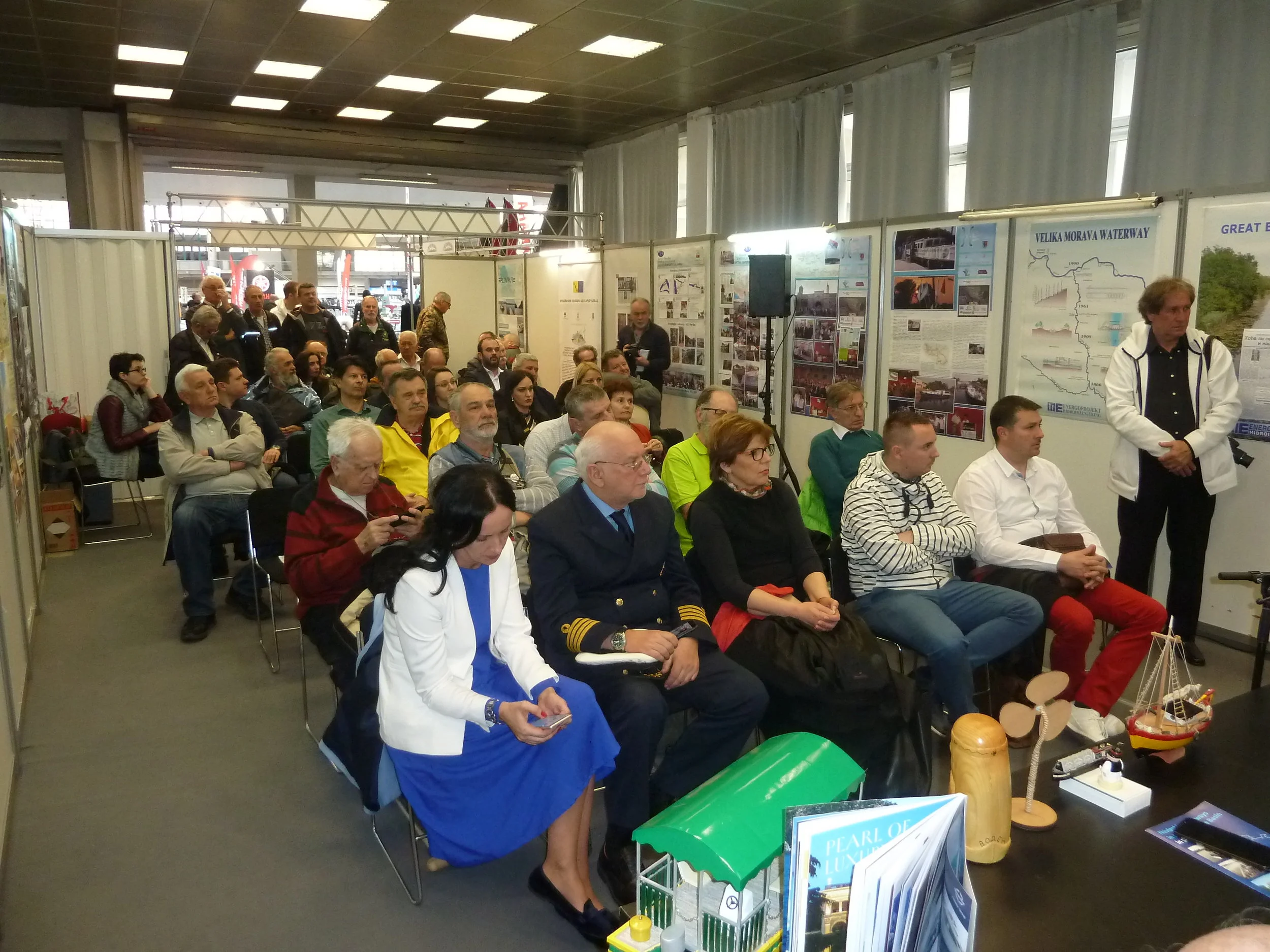
The Blue Flag programme at the 41st International Nautical Fair in Belgrade, Serbia.
Environmental Ambassadors for Sustainable Development as the National Operator of the Blue Flag programme in Serbia, has been invited by the organization Danube Propeller to present the programme during the 41st International Fair on nautical, hunting and fishing, held in Belgrade in March 2019.
Environmental Ambassadors for Sustainable Development as the National Operator of the Blue Flag programme in Serbia, has been invited by the organization Danube Propeller to present the Blue Flag programme during the 41st International Fair on nautical, hunting and fishing, held in Belgrade from March 1st to 5th, 2019.

Danube propeller in cooperation with the NATUS group (NATUS has been a cluster of nautical economy and nautical tourism, since 1992, within the Serbian Chamber of Commerce and Economy), traditionally organise thematic lectures from nautical areas.
Serbia has a remarkable network of inland waterways. It is the second riparian state on the Danube by length. The Danube flows through the country from km 1433 to km 845.65, a length of 587 km, the first 137.5 km being shared with Croatia (right bank) and the last 229 km with Romania (left bank). Serbia has about 1860 km of navigable waterways, including the network of 693 km of canals and navigable rivers, managed by the public water management company (PWMC) Vode Vojvodine. Vode Vojvodine manages the Danube-Tisa-Danube Canal (Канал Дунав-Тиса-Дунав). This extensive canal network in Serbia is a unique hydro-engineering system for flood control and water management, land improvement and agriculture, forestry, water supply, waste water disposal, navigation, tourism, fishing and hunting. In central Serbia, it is estimated that there are an additional 650 km of rivers suitable for nautical tourism (classes RA and RB). The total length available for recreational boats or nautical tourism throughout Serbia is estimated at more than 3000 km.

The association Danube Propeller was formally established in 2007, with the mission to establish and reinforce citizens’ common interest in development, maintenance and use of the waterways in Serbia and the Middle Danube region. Our main aim is to create, coordinate and maintain a sustainable future for the Serbian nautical industry on rivers, canals and lakes oxbows, former gravel or sand pits, where nautical tourism is underdeveloped. The association Danube Propeller is a partner of IWI (Inland Waterways International) and a member of FEE Council in Serbia and Blue Flag national jury.


Everyone welcome down by the sea
The iconic Blue Flag, the world’s most recognised voluntary eco-label for protecting our coasts, has today signed a new partnership with Total Beach Access which will change the face of beaches worldwide, by increasing accessibility and inclusivity for all, at no cost to the public.
The iconic Blue Flag, the world’s most recognised voluntary eco-label for protecting our coasts, has today signed a new partnership with Total Beach Access which will change the face of beaches worldwide, by increasing accessibility and inclusivity for all, at no cost to the public.
“This ground-breaking new partnership is a real game-changer that will ensure our Blue Flag beaches are accessible to everyone including the elderly, families with baby buggies and people with physical disabilities or visual impairments. It will impact the experience of millions,” says International Blue Flag Programme Director Sophie Bachet Granados.
“Blue Flag and Total Beach Access working together can change the world by welcoming those who previously struggled to navigate their way to the water. This is a necessary change so that all people have the same opportunity to enjoy the beach,” says Connie Skibicki from Total Beach Access.

How does it work?
Accessibility for all will be achieved through two integral components. A specially-made walkway system will be placed on a Blue Flag awarded beach allowing wheelchair users and families with prams easy access over soft sand or small pebbles. This will be equipped with special devices to guide the visually impaired using a phone app.

“Access to the beach is the first part, but we also wanted to make sure people with physical disabilities didn’t just have to just stay on the beach and watch others enjoy the water. So we have designed a state-of-the-art amphibious wheelchair which will allow them to go in as well,” says Connie Skibicki.

Partnership
“Wheelchair accessibility is becoming more important for public authorities around the world. So, in response, Blue Flag and Total Beach Access are now providing beach access walkways, amphibious wheelchairs and wireless technology to councils. This is possible due to our commercial sponsors that see the humanitarian importance of equal access to our beaches and oceans,” says Connie.
Cape Verde, Colombia, Finland, India and South Korea, are currently working on their pilot sites and the first Blue Flag beach to reap the benefits will be announced this summer. There are currently more than 3750 Blue Flag beaches in 44 countries around the world.
“It’s quite simple: we have linked with sponsors who wish to increase beach accessibility. Through sensitive advertising on both products, sponsors are contributing to this valuable change thus allowing councils with Blue Flag awarded beaches the use of walkways and amphibious wheelchairs for free,” explains Sophie Bachet Granados.
“Although there is no cost involved for the beach, we have not compromised on quality. The products all incorporate advanced design features and made to very strict quality controls as well as carbon neutral and can be re-used or recycled,” Sophie adds.
Blue Flag International Jury member, Jesus Hernández Galán, Vice President of ENAT, the European Network for Accessible Tourism, adds: “ENAT is proud to promote this global initiative, which will surely make a huge difference to family members and individuals who have mobility or vision limitations. No-one should be denied the possibility to enjoy a visit to the beach and experience sea bathing, if they wish. This ambitious collaboration can really open up new leisure possibilities for tourists and locals alike.”
“Improving the sustainable development of local communities through tourism is one of the unique potentials of the tourism sector and creates lasting values,” added Dr. Dirk Glaesser, Director of Sustainable Tourism Development at the World Tourism Organization (UNWTO) and member of the international jury of the Blue Flag.
“Blue Flag has always been a front-runner, and with this new global partnership, we intend to continue to strive for excellence and beyond,” concludes Sophie.
http://www.blueflag.global/all-bf-sites
Video about the partnership:
Short Info about Blue Flag
The iconic Blue Flag is the world’s most recognised voluntary eco-label awarded to beaches, marinas, and sustainable boating tourism operators. In order to qualify for the Blue Flag, a series of stringent environmental, educational, safety, and accessibility criteria must be met and maintained.
Short Info about Total Beach Access:
World-leading provider of universal walkway system, all terrain and amphibious wheelchairs.
Short Info about European Network for Accessible Tourism
The leading non-profit membership association supporting public authorities, destinations and businesses in their efforts to develop sustainable, accessible and inclusive tourism.
https://www.accessibletourism.org
Press Contact:
Blue Flag: Sophie Bachet Granados, +45 31 23 88 66, sophie@fee.global
Total Beach Access: +45 22 29 53 51, connie@totalbeachaccess.com